

Is Core Web Vitals 2026 Different? What Changed and What Is Rumor
The thresholds have not moved: LCP 2.5s, INP 200ms, CLS 0.1, at the 75th percentile. What changed is how loudly some posts claim otherwise. Check the primary source before you…
Umair Khan •
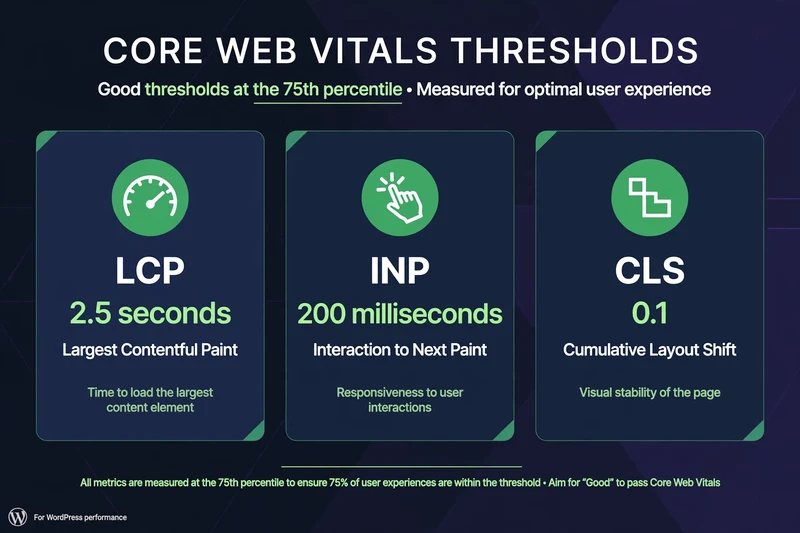
Core Web Vitals 2026 is less about new metrics than about separating documented facts from rumors. If you search for Core Web Vitals in 2026, you will find three very different stories. One says Google added a new metric. Another says Google tightened LCP from 2.5 seconds to 2.0 seconds. A third says Core Web Vitals now dominate rankings.
Those stories cannot all be true, and the way to tell them apart is to go to the primary source: Google’s own web.dev Core Web Vitals documentation and Google Search Central. Secondary blog posts, even well-meaning ones, are not the source. This post separates what Google’s documentation actually says from what is rumor, as of the research for this post, and tells you what to recheck before you act on it.
To measure your own LCP, INP, and CLS, use the best WordPress speed test tools, and for caching that helps LCP, see the best WordPress cache plugins review.
Did Google Add a Fourth Metric?
Rumor: No, not as a Core Web Vital.
Core Web Vitals are still three metrics: Largest Contentful Paint (LCP), Interaction to Next Paint (INP), and Cumulative Layout Shift (CLS). INP replaced First Input Delay (FID) in March 2024, because FID only measured the first interaction and missed later sluggishness. That replacement is often misread as a “new metric in 2026,” but it was not a 2026 change, and it did not add a fourth metric.
Google does track many other Web Vitals, such as Time to First Byte (TTFB) and First Contentful Paint (FCP), as diagnostics. Those are useful, but they are not Core Web Vitals, and they do not count toward the Core Web Vitals assessment in Search Console in the same way. If a post claims a fourth Core Web Vital without linking to a Google announcement or a web.dev changelog entry, treat it as unconfirmed.
Did Thresholds Change?
Fact, as documented: No, the “good” thresholds have not moved.
The thresholds documented by Google are:
- LCP: good at 2.5 seconds or less, needs improvement from 2.5 to 4.0 seconds, poor over 4.0 seconds
- INP: good at 200 milliseconds or less, needs improvement from 200 to 500 milliseconds, poor over 500 milliseconds
- CLS: good at 0.1 or less, needs improvement from 0.1 to 0.25, poor over 0.25

Those thresholds are assessed at the 75th percentile of real user visits, per URL group, from Chrome UX Report (CrUX) field data over a rolling 28-day window. That 75th percentile rule matters: a site can have a good median and still fail, if the slowest quarter of real visits are poor.
The specific rumor to ignore is that LCP was tightened to 2.0 seconds. No page in Google’s documentation found for this post says that, and multiple 2026 sources that cite web.dev repeat 2.5 seconds as the good threshold. Google’s own Web Vitals documentation also says developers should expect definitions and thresholds to be stable, with changes announced in advance and documented in a public changelog. If Google tightens a threshold, you should hear it from Google first, not from an article with no source.
Recheck web.dev on the week you publish this post. If Google has announced a change by then, update the thresholds above and link to the announcement. Do not keep the old numbers if Google has changed them, and do not change them based on a rumor.
Are Core Web Vitals a Ranking Factor?
Fact, with nuance: Yes, but as one signal among many, not as the dominant factor.
Google has consistently described Core Web Vitals as part of the page experience signals in its ranking systems, not as a replacement for relevance, content quality, or helpfulness. A fast page with thin or irrelevant content does not outrank a helpful page on content alone because of speed, and a slow page with the best answer does not automatically disappear because of speed.
That nuance is often lost in posts that claim a 2026 core update “massively increased” the weight of Core Web Vitals, without a Google source for that weight change. Core updates change many things at once, including how content quality is assessed, so attributing a ranking change to Core Web Vitals alone, without field data and a controlled comparison, is speculation.
The stronger, less speculative reason to fix Core Web Vitals is not ranking weight. It is conversion and user experience: a page that loads in 2.5 seconds, responds in under 200 milliseconds, and does not shift layout keeps more shoppers than a page that does not, regardless of its exact ranking weight. That effect is measurable on your own site, in your own analytics, without relying on a ranking claim.
What Actually Got Harder in 2026?
If thresholds did not move, why does passing feel harder? Three honest reasons, none of which require a new metric:
- The web got heavier: more third-party scripts, larger images, and more interactive elements on the same pages, especially on e-commerce and page-builder sites
- INP is stricter in practice than FID was: INP measures every interaction during a visit, not just the first, so a site that passed FID can fail INP if later clicks are slow.
- Field data is unforgiving: lab scores on a fast developer machine do not match real users on slow phones and slow networks. A site that passes in Lighthouse can still fail in CrUX field data.
Fixing those three reasons — fewer heavy scripts, faster interactions, and real-user field data as the target — will help whether or not Google ever changes a threshold.
How to Verify a Core Web Vitals Claim in 2 Minutes
- Does the claim link to web.dev or Google Search Central, or only to another blog post?
- Does it quote a specific threshold, date, and changelog entry, or does it say “Google just changed”?
- Does it confuse a lab score, a Lighthouse score, and a CrUX field assessment? Those are three different things.
- Does it claim a ranking weight change without field data or a Google announcement?
If a claim fails those checks, do not rebuild your site around it. Fix LCP, INP, and CLS to the documented thresholds, measure field data over 28 days, and revisit the claim when Google announces something.

Next in this series: the Core Web Vitals pillar guide, and the INP pillar guide for WordPress.
Common Questions
Frequently Asked Questions
Straight answers about the three metrics, their thresholds, and how to check a claim before acting on it.
Keep reading
-

PageSpeed Looks Good but Core Web Vitals Fail? Lab vs Field Data Explained
A good lab score does not always mean a passing Core Web…November 9, 2026 -

Are Google Fonts Slowing Down WordPress? How to Fix Slow, Shifting Text
Text that appears late, flashes, or jumps after loading can make a…November 5, 2026 -

WordPress Slow on Mobile Only? How to Find the Mobile-Only Cause
Your site feels fine on a laptop but slow on a phone….November 2, 2026
2 responses to “Is Core Web Vitals 2026 Different? What Changed and What Is Rumor”
-
[…] in this series: Core Web Vitals 2026 myth-bust, WooCommerce Speed Optimization pillar, and Query Monitor Tutorial. Fix INP in Elementor and […]
-
[…] the next step is knowing what they mean and what to fix. For Core Web Vitals claims, see my Core Web Vitals 2026 myth-bust. For slow responses to clicks and taps, see my INP pillar. And if a slow tool result points to […]
Leave a Reply