Tag: Conversion Rate Optimization

  • 5 CRO Fixes That Can Double Your Website Leads Without More Ad Spend

    5 CRO Fixes That Can Double Your Website Leads Without More Ad Spend

    More traffic is not always the answer.

    If 10,000 people visit your website every month but only 50 contact you, buying more traffic can simply mean paying to send more people into the same broken funnel.

    Conversion rate optimization, or CRO, starts somewhere else.

    Find the points where visitors hesitate, get confused, lose trust, abandon a form, or simply cannot figure out what to do next.

    Fix those points.

    A website that turns 1% of visitors into leads and moves to 2% does not need twice the traffic to generate twice the leads. The traffic stays the same. The website gets better at converting.
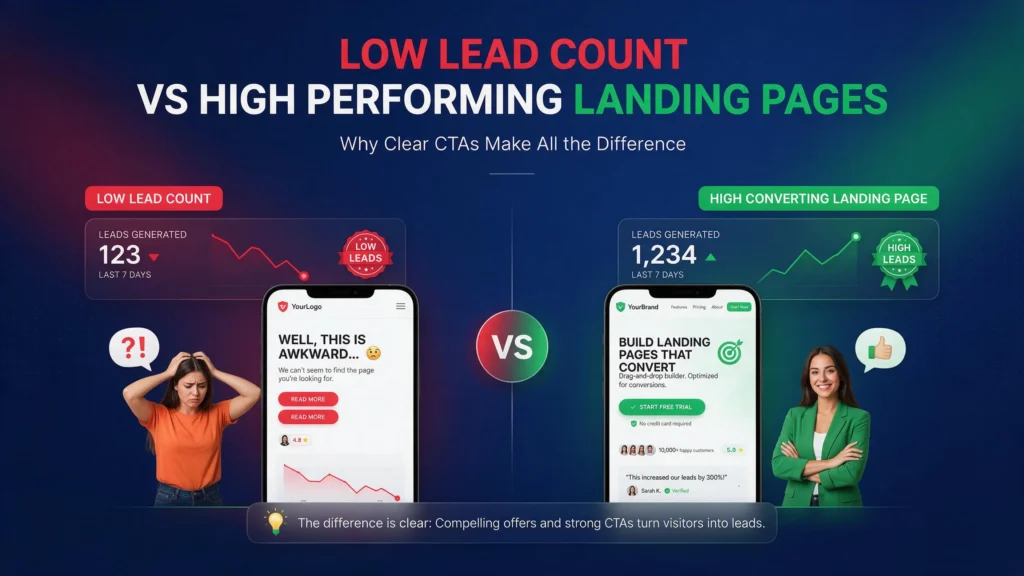
    5 CRO fixes to double website leads without more ad spend

    That is the basic CRO opportunity.

    No CRO change can guarantee that your leads will double. Results depend on traffic quality, offer, pricing, audience, industry, brand trust, and the existing conversion rate. But when a website has obvious conversion problems, fixing several of them can drive big gains without increasing the ad budget.

    Here are five CRO fixes worth checking first.

    Why More Traffic Is Not Always the Answer

    Most businesses look at a traffic report and ask one question:

    How do we get more visitors?

    That is useful, but incomplete.

    A better question is:

    What happens after visitors arrive?

    Imagine a local service website gets 5,000 monthly visitors and generates 50 qualified inquiries. That is a 1% visitor-to-lead rate.

    If traffic increases to 10,000 visitors but the conversion rate stays at 1%, the business gets about 100 inquiries.

    But if the website improves from 1% to 2% while traffic stays at 5,000, the business also gets about 100 inquiries.

    That is why CRO matters.

    You are improving the output from traffic you already paid for through SEO, Google Ads, social media, referrals, email, or content.

    The first job is not redesigning the entire website.

    The first job is finding where potential customers disappear.

    Find Where Leads Disappear

    Start with actual behavior.

    Look at:

    • Landing pages
    • Contact form starts
    • Contact form submissions
    • Phone clicks
    • Email clicks
    • Booking starts
    • Booking completions
    • Add-to-cart events
    • Checkout starts
    • Purchases
    • Mobile versus desktop performance
    • Traffic source
    • Device type
    • Page-level conversion rates

    Google Analytics currently uses key events to identify important actions for a business. A lead form submission can be tracked as a key event, allowing you to analyze the paths users take before completing the form.

    This matters because pageviews alone tell you very little.

    A page can receive 20,000 visitors and generate almost nothing.

    Another page can receive 2,000 visitors and produce 80 qualified leads.

    The second page may be the better business asset.

    Measure the action that actually creates value.

    Fix #1: Make the Primary CTA Impossible to Miss

    Your visitor should never have to ask:

    “What am I supposed to do here?”

    This happens constantly.

    A service page might have a large hero image, a headline, three paragraphs of company history, several navigation links, social icons, four different buttons, and finally a tiny “Contact Us” link.

    The website technically has a CTA.

    The visitor still has no clear path.

    Your primary CTA should tell people what happens next.

    Weak:

    Submit

    Better:

    Request a Free Quote

    Weak:

    Learn More

    Better:

    See How We Can Improve Your Website

    Weak:

    Contact

    Better:

    Book a 15-Minute Consultation

    The exact wording depends on the business.

    The principle is simple.

    Make the next action obvious.

    One Page, One Main Action

    This does not mean every page needs only one button.

    It means every important page should have a clear primary conversion goal.

    A service page should not compete equally between:

    • Read our blog
    • Follow us
    • Meet the team
    • View our history
    • Download our brochure
    • Contact sales
    • Subscribe
    • Book a call

    Too many equal choices create friction.

    For a lead-generation page, decide what matters most.

    Maybe it is:

    Request a Quote

    Then make that action visually obvious.

    Place it where users naturally look:

    • Near the top
    • After the main value proposition
    • Near important proof
    • Near pricing or service details
    • At the end of the page
    • On mobile where appropriate

    Do not rely on the navigation menu to carry your conversions.

    Your visitor should be able to understand the next step without hunting.

    Fix #2: Remove Friction From Your Forms

    Forms are where many websites lose leads.

    A visitor can be interested.

    They can trust the business.

    They can like the offer.

    Then they see this:

    Name

    First Name

    Last Name

    Company

    Job Title

    Address

    City

    State

    ZIP

    Phone

    Email

    Website

    Budget

    How did you hear about us?

    Tell us about your project

    Upload a file

    Subscribe to newsletter

    And they leave.

    The business may think:

    “We need this information.”

    The visitor thinks:

    “This is too much work.”

    Those are very different perspectives.

    Baymard’s recent ecommerce research continues to show the relationship between form complexity and usability. Its 2024 research found an average checkout contained 11.3 form fields, while its testing found that the number of fields users must deal with matters more than simply counting checkout steps.

    For lead-generation websites, the lesson is not “every form must have three fields.”

    The lesson is:

    Every field should earn its place.

    Ask Only What Sales Actually Needs

    Before keeping a field, ask:

    Will this information change what happens after submission?

    If not, remove it.

    If the sales team only needs:

    • Name
    • Email
    • Phone
    • Project details

    Start there.

    You can collect additional information later.

    A lead who submits four useful fields is better than a potential lead who abandons a twelve-field form.

    For ecommerce, the same principle applies to checkout.

    Baymard’s current checkout research reports that 63% of mobile ecommerce sites and 64% of desktop sites in its 2025 benchmark had mediocre or worse checkout UX. Its research also identifies unnecessary fields, unclear requirements, poor error handling, and other interaction problems as recurring issues.

    Make Form Errors Easy to Fix

    A form should not simply say:

    “There was an error.”

    Which field?

    What went wrong?

    What should the visitor enter?

    W3C’s WCAG guidance says automatically detected input errors should identify the field and describe the error in text.

    Good:

    Email: Please enter a valid email address.

    Bad:

    Invalid submission.

    Good error handling reduces confusion.

    It also helps accessibility.

    W3C recommends properly labeling form controls so users and assistive technologies can understand what each control is for.

    That is not just an accessibility concern.

    Clear forms are easier for everyone to use.

    Fix #3: Rewrite the Above-the-Fold Message Around the Customer

    Your homepage may look beautiful.

    That does not mean it communicates value.

    One of the most common CRO problems is writing about the company instead of the customer.

    Example:

    “We are a full-service digital agency with over 15 years of experience.”

    That tells the visitor about you.

    Try:

    “Get a Faster WordPress Website That Converts More Visitors Into Leads.”

    Now the visitor immediately understands the problem you solve.

    The first screen should answer three questions quickly:

    What do you do?

    Who is it for?

    Why should I care?

    If those answers are unclear, visitors have to work to understand your offer.

    Most will not.

    Match the Message to Search Intent

    Do not send every visitor to the same generic homepage.

    Someone searching:

    emergency plumber in Miami

    has a different intent from someone searching:

    commercial plumbing maintenance

    Someone searching:

    WordPress speed optimization

    has different intent from someone searching:

    WordPress developer

    The landing page should reflect that intent.

    If someone searches for WordPress speed optimization and lands on a page that spends the first 600 words discussing general web development, the message is mismatched.

    The visitor wanted one thing.

    Give them that thing.

    This is where SEO and CRO overlap.

    Better targeting can bring more relevant visitors.

    Better messaging can help those visitors take action.

    You do not need more traffic if your existing traffic is landing on the wrong page.

    Fix #4: Speed Up the Mobile Experience

    This is where technical optimization becomes CRO.

    A slow website creates friction before the visitor even sees the offer.

    The visitor taps.

    The page begins loading.

    Nothing useful appears.

    They wait.

    A script blocks interaction.

    An image shifts the page.

    The browser freezes.

    The visitor leaves.

    You lost the lead before your sales copy had a chance.

    If you want to understand exactly how this happens and what to fix first, read our full breakdown of why your website’s mobile speed is killing your lead generation; it covers LCP, INP, CLS, and the WordPress-specific bottlenecks most businesses miss.

    For CRO, the important point is simple:

    Performance is part of the conversion experience.

    Performance Is Not Just a PageSpeed Score

    Do not optimize a website only because a testing tool gives it a number.

    Look at the actual problems.

    For example:

    • Huge hero images
    • Render-blocking CSS
    • Unused JavaScript
    • Third-party scripts
    • Heavy page builders
    • Excessive plugins
    • Poor caching
    • Slow hosting
    • Font loading problems
    • Layout shifts
    • Long main-thread tasks
    • Slow server response
    • Unoptimized WooCommerce functionality

    A page can have a reasonable desktop score and still feel terrible on a mid-range mobile device.

    That is why field data matters. We cover this in detail in our guide on why PageSpeed scores don’t matter as much as most people assume.

    The real customer experience matters more than making a test report look pretty.

    This is also where root-level WordPress optimization can produce a CRO benefit.

    Removing unnecessary scripts, properly minifying CSS and JavaScript, improving caching, optimizing images, reducing plugin overhead, and fixing server-side bottlenecks can reduce friction throughout the funnel.

    The goal is not:

    “Get 100/100.”

    The goal is:

    “Make it easier for the customer to complete the action.”

    Fix #5: Add Proof Where the Decision Happens

    Trust is not something you should hide on an “About Us” page.

    Put proof next to the decision.

    If the visitor is deciding whether to:

    • Request a quote
    • Book a consultation
    • Buy a product
    • Start a subscription
    • Call your business

    show relevant proof nearby.

    This can include:

    • Customer reviews
    • Case studies
    • Specific results
    • Before-and-after examples
    • Client logos
    • Certifications
    • Guarantees
    • Product ratings
    • Security information
    • Clear return policies
    • Relevant testimonials

    But do not dump 40 testimonials into one section.

    Match proof to the concern.

    If you sell expensive website development, show examples of websites you built.

    If you sell SEO, show measurable SEO outcomes.

    If you sell a medical service, explain credentials and provide appropriate trust information.

    If you sell ecommerce products, make shipping, returns, payment, and product information easy to understand.

    Proof Should Support the CTA

    Imagine a visitor reads:

    “Ready to improve your website?”

    Then immediately sees:

    “Trusted by hundreds of businesses.”

    That is better than putting the same statement somewhere near the footer.

    Even better is specific proof.

    Instead of:

    “We deliver amazing results.”

    Use:

    “Reduced page load time from 6.2s to 1.4s on a lead-generation website.”

    Specific evidence is easier to understand.

    The same principle applies to ecommerce.

    Baymard’s recent payment UX research emphasizes that users need confidence around payment details, total cost, security, and what happens when something goes wrong.

    Trust is not decoration.

    It removes uncertainty.

    Stop Sending Every Visitor to Your Homepage

    The homepage is not a universal landing page.

    It has too many jobs.

    It introduces the company.

    It supports navigation.

    It explains products or services.

    It may target multiple audiences.

    It may rank for branded searches.

    It may contain company information.

    A dedicated landing page has one job.

    That makes it easier to optimize.

    For example:

    /wordpress-speed-optimization/

    can focus entirely on WordPress performance.

    /hvac-web-design/

    can focus entirely on HVAC businesses.

    /emergency-plumber/

    can focus entirely on emergency plumbing.

    The visitor arrives.

    The headline matches the search.

    The offer is clear.

    The proof is relevant.

    The CTA is obvious.

    That is a much cleaner conversion path.

    Build Dedicated Landing Pages

    Good landing pages do not need to be complicated.

    A strong structure can be:

    Problem

    What is going wrong?

    Outcome

    What does the customer want?

    Solution

    How do you solve it?

    Proof

    Why should they believe you?

    Process

    What happens next?

    CTA

    What should they do?

    For example, a WordPress speed page might open with:

    Your WordPress Website Is Slow. We Fix the Problems Causing It.

    Then explain:

    • What is slowing the site
    • What gets optimized
    • What happens during the audit
    • What tools are used
    • What results have been achieved
    • What the client receives
    • How to start

    That is much stronger than:

    “Welcome to our digital agency.”

    Fix Broken Contact and Booking Flows

    This sounds obvious.

    Many businesses still lose leads here.

    Test the complete journey yourself.

    Do not just test whether the page loads.

    Submit the form.

    Call the number.

    Book the appointment.

    Use a phone.

    Use Chrome.

    Use Safari.

    Try a slow connection.

    Check the confirmation.

    Check the email notification.

    Check the CRM.

    Check whether the sales team actually receives the lead.

    A form that displays “Thank you” but never sends the lead notification is not a functioning conversion system.

    Neither is a booking form that works on desktop but fails on mobile.

    Neither is a phone number that is visible but not clickable on mobile.

    CRO is not only about design.

    It is about the entire path from visitor to customer.

    Use Analytics Before Changing the Design

    Do not redesign a website because you personally dislike the hero section.

    That is not CRO.

    That is preference.

    Start with evidence.

    Google Analytics lets you define important actions as key events and analyze how users reach those actions. Google specifically documents lead-generation form submissions as an example of an important key event.

    Track things such as:

    Page view → CTA click → form start → form submit

    For ecommerce:

    Product view → add to cart → checkout → purchase

    Now you can identify the leak.

    Example:

    100,000 visitors

    ↓

    12,000 product views

    ↓

    3,000 add to carts

    ↓

    1,000 checkout starts

    ↓

    400 purchases

    Do not randomly optimize the homepage.

    Look at the biggest problem in the funnel.

    If thousands of people add products to carts but only 400 purchase, checkout deserves investigation.

    If visitors rarely click the CTA, the problem may be messaging or offer clarity.

    If visitors start the form but do not submit, form friction deserves attention.

    Measure first.

    Then change.

    Track Micro-Conversions

    Not every visitor is ready to buy immediately.

    That does not mean their behavior is useless.

    Track meaningful actions such as:

    • CTA clicks
    • Phone clicks
    • Email clicks
    • Form starts
    • Form submissions
    • Pricing-page visits
    • Booking starts
    • Downloads
    • Product views
    • Add-to-cart
    • Checkout starts
    • Video engagement

    But do not treat every click as a business conversion.

    A visitor scrolling 90% down a page is not the same as someone requesting a quote.

    Google Analytics separates important business actions as key events and allows businesses to use those events for reporting and optimization.

    Your tracking should reflect the actual business goal.

    A/B Testing Without Guessing

    Once you identify a problem, test the solution.

    Do not change ten things at once and then claim the redesign increased conversions.

    You will not know what caused the result.

    A cleaner experiment might test:

    Version A: “Get a Free Quote”

    Version B: “Request Your Project Estimate”

    Or:

    Version A: Long form

    Version B: Short form

    Or:

    Version A: Generic headline

    Version B: Problem-focused headline

    The goal is not to make the page prettier.

    The goal is to learn what helps users complete the desired action.

    For low-traffic websites, formal A/B testing can take a long time to reach useful confidence.

    That does not mean you cannot improve the site.

    Use multiple evidence sources:

    • Analytics
    • Search data
    • User recordings
    • Heatmaps
    • Form abandonment
    • Customer questions
    • Sales-team feedback
    • Support tickets
    • Direct user feedback

    Then make controlled changes.

    CRO for Local Service Businesses

    Local businesses often have a simple conversion goal:

    Get the visitor to call, book, or request a quote.

    Do not bury those actions.

    A local service page should quickly communicate:

    Service

    What do you provide?

    Location

    Where do you provide it?

    Availability

    When can the customer get help?

    Trust

    Why should they choose you?

    Action

    What should they do now?

    For example, an HVAC company can build dedicated pages for:

    • AC repair
    • AC installation
    • Heating repair
    • Emergency service
    • Commercial HVAC

    Each page can target a specific problem and location.

    The CTA can then match the intent.

    Call for Emergency AC Repair

    is stronger than:

    Learn More About Our Services

    when the visitor is actively searching for emergency repair.

    CRO for Ecommerce Stores

    Ecommerce CRO has another layer.

    The visitor must move through more steps:

    Product discovery → product page → cart → checkout → payment → confirmation

    Every step creates potential friction.

    Baymard’s current research places global cart abandonment at around 70%, based on its long-running dataset, and its checkout research identifies significant usability problems across both desktop and mobile ecommerce experiences.

    That does not mean every abandoned cart can be recovered.

    It means the checkout deserves serious attention.

    Look for:

    • Unexpected costs
    • Unclear shipping
    • Forced account creation
    • Too many fields
    • Poor mobile layout
    • Confusing error messages
    • Weak payment confidence
    • Slow checkout
    • Missing product information
    • Difficult coupon handling
    • Poor return information

    Baymard’s research also shows that reducing unnecessary form fields can improve checkout usability, with its 2024 benchmark finding 11.3 fields on average compared with its finding that many checkouts could function with fewer.

    Do not optimize ecommerce checkout by blindly making it shorter.

    Optimize the actual work users must perform.

    What Not to Change

    CRO does not mean changing everything.

    Do not remove useful information simply because you want a shorter page.

    Do not hide important pricing information to force users into a sales call.

    Do not add fake urgency.

    Do not add popups every five seconds.

    Do not make the CTA visually aggressive.

    Do not remove navigation when users genuinely need it.

    Do not sacrifice accessibility for aesthetics.

    Do not remove product details because someone told you “short pages convert better.”

    Do not assume a competitor’s layout will work for your audience.

    And do not chase a higher conversion percentage while lead quality collapses.

    If your conversion rate rises from 2% to 4% but half the new leads are useless, the business may not have improved.

    Measure qualified leads, not just raw submissions.

    How to Prioritize CRO Work

    You do not need a six-month CRO project to find useful improvements.

    Start with the biggest leaks.

    Use a simple framework:

    Impact

    How many users experience the problem?

    Severity

    How badly does it affect their ability to convert?

    Confidence

    Do you have evidence that this is actually happening?

    Effort

    How difficult is the fix?

    A broken mobile form can affect a huge percentage of visitors and may be relatively easy to fix.

    That should probably be investigated before changing the color of a button.

    A 3% difference in button color is not more important than a form that fails.

    Technical problems come first.

    Conversion clarity comes next.

    Visual polish comes after that.

    30-Day CRO Plan

    You can structure the first month like this.

    Week 1: Measure

    Set up or audit analytics.

    Define key events.

    Track leads, phone clicks, form submissions, bookings, add-to-cart, checkout, and purchases where relevant.

    Identify the highest-value pages.

    Week 2: Remove Friction

    Test forms.

    Test mobile.

    Test contact flows.

    Test booking.

    Test checkout.

    Fix broken links.

    Fix confusing errors.

    Remove unnecessary fields.

    Week 3: Improve Messaging

    Rewrite weak headlines.

    Clarify offers.

    Strengthen CTAs.

    Add relevant proof.

    Create dedicated landing pages for important search intent.

    Week 4: Test and Measure

    Compare performance before and after.

    Review key event rates.

    Look at lead quality.

    Identify the next bottleneck.

    Then repeat.

    CRO is not a one-time redesign.

    It is a loop:

    Measure → Find friction → Fix → Test → Measure again.

    That is how you turn CRO from opinion into a process.

    Conclusion

    You do not always need more traffic.

    Sometimes you need to stop wasting the traffic you already have.

    Start with the five areas that create the most obvious friction:

    Make the CTA clear.

    Reduce form friction.

    Make the message about the customer’s problem.

    Improve mobile performance.

    Put proof next to the decision.

    Then measure what happens.

    A website generating 50 leads from 5,000 visitors has a different problem from a website generating 500 leads from 50,000 visitors.

    Traffic tells you how many people arrived.

    CRO tells you what happened after they arrived.

    That distinction matters.

    For WordPress websites, CRO often overlaps with development, technical SEO, UX, and performance optimization. A slow script, broken form, bloated plugin stack, poor mobile layout, or weak landing-page structure can all become conversion problems.

    If your website has performance issues contributing to lead loss, our WordPress speed optimization services are designed to remove that friction at the root level.

    The strongest CRO work does not begin with:

    “Let’s redesign the website.”

    It begins with:

    “Where are potential customers getting stuck?”

    Find that point.

    Fix it.

    Measure the result.

    Then move to the next bottleneck.

    Traffic tells you how many people arrived. CRO tells you what happened after they arrived. That distinction matters. If you want help identifying exactly where your potential customers are getting stuck, book a free call and we will walk through your funnel together.

    FAQs

    Can CRO really double website leads?

    It can happen, but there is no universal guarantee. A website with serious conversion problems has more room for improvement than one that is already highly optimized. Doubling leads can also come from several smaller improvements working together rather than one dramatic change.

    What should I optimize first?

    Start with the biggest measurable bottleneck. Check forms, CTAs, mobile performance, landing-page messaging, booking flows, and checkout. Use analytics to identify where users are dropping out before changing the design.

    How many fields should a lead-generation form have?

    There is no universal number. Keep the fields required to qualify and process the lead, then remove anything that does not provide enough business value to justify the extra friction. Ecommerce research from Baymard shows that unnecessary form fields can significantly increase interaction effort.

    Does website speed affect conversion rate?

    Speed can affect the user experience and therefore can affect conversion behavior. Core Web Vitals measure loading, responsiveness, and visual stability through LCP, INP, and CLS. The practical goal should not be chasing a perfect laboratory score. The goal is making important pages fast and responsive for real users.

    What should I track for CRO?

    Track actions connected to business value. For lead generation, this can include form submissions, phone clicks, booking completions, and qualified leads. For ecommerce, track product views, add-to-cart, checkout starts, purchases, and revenue. Google Analytics supports defining important user actions as key events so you can analyze those behaviors across your traffic sources.

  • Why Your Website’s Mobile Speed Is Killing Your Lead Generation

    Why Your Website’s Mobile Speed Is Killing Your Lead Generation

    Your website may have beautiful design, strong branding, good services, persuasive copy, and clear calls to action. None of that matters much if potential customer taps your Google result on phone, waits, watches blank screen, tries to scroll, and leaves before page becomes usable. Mobile speed is not only technical SEO problem. It is lead generation problem. When page loads slowly, every form submission, phone call, booking, quote request, product purchase, and consultation opportunity sits behind unnecessary friction. That is exactly what our WordPress speed optimization services are designed to remove.

    Google’s current web guidance treats Core Web Vitals as important user-experience measurements covering loading performance, responsiveness, and visual stability. Google also continues to treat INP as a Core Web Vital, replacing FID. But numbers only tell part story. Business owner does not lose lead because LCP number is 4.8 seconds. Business loses lead because person wanted answer now and website made them wait. That distinction matters when optimizing a real business website. You are not optimizing numbers for their own sake. You are reducing friction between customer intent and customer action.

    A slow mobile website costs you leads every day. Learn how LCP, INP, and CLS affect conversions and what to fix first on your WordPress site.

    Think about it like physical store. Customer walks through door and asks employee, “Can you help me?” Employee stares at them for five seconds before responding. Then every time customer touches product, employee freezes. Then checkout counter jumps sideways while customer reaches for wallet. Would customer trust store? Probably not. Slow website creates similar experience, except visitor can leave with one thumb tap and visit competitor.

    Mobile Speed Is Now a Lead Generation Problem

    Many businesses still treat website speed as something developers worry about after design is complete. Marketing team handles leads. Designer handles appearance. SEO person handles rankings. Developer handles speed. Problem: these things are connected.

    Suppose local roofing company gets 1,000 monthly mobile visitors. Website receives traffic from Google, Facebook, paid ads, referrals, and Google Maps. Homepage loads slowly. Service pages contain huge images. Contact form loads several scripts. Phone button is buried below large hero section. User clicks “Get Free Estimate,” but JavaScript takes time to respond. Some visitors leave. Others never reach form. Business may blame ads, seasonality, weak offer, or poor traffic quality. Actual problem sits inside website experience.

    Google’s older mobile-performance research found strong relationship between slower mobile experiences and user behavior. One Google/ SOASTA analysis reported that mobile pages loading one second faster saw up to 27% higher conversion rates, while bounce rates increased sharply as load time increased. Those figures come from older research, so they should not be treated as universal 2026 conversion benchmarks, but they demonstrate why performance can affect commercial outcomes.

    Visitors Do Not Care Why Website Is Slow

    Visitors do not know the website uses Elementor. Visitor does not know hosting company. Visitor does not know 47 plugins are active. Visitor does not know marketing team installed three tracking systems. Visitor does not know hero video is 8 MB.

    Visitor sees one thing:

    Website is slow.

    That is all.

    And visitor has options.

    Google search result contains competitor. Browser back button works instantly. Search engine does not charge visitor for switching websites. There is no reason for user to wait patiently while your homepage negotiates with six third-party servers and downloads massive JavaScript bundle.

    This is why speed optimization should begin with customer journey.

    Find important pages. Find pages receiving mobile traffic. Find pages generating leads. Test those pages. Fix highest-impact bottlenecks first.

    Do not spend three hours optimizing footer icon that contributes nothing to conversion while 2 MB hero image delays main content.

    Why Mobile Users Leave Slow Websites

    Mobile browsing happens under messy conditions. User may have weak Wi-Fi. User may use cellular connection. User may be commuting. User may have older phone. Browser may have limited resources. Battery may be low. Multiple apps may run in background.

    Desktop test from fast office connection tells only small part of story.

    Google’s mobile-speed research has repeatedly highlighted relationship between loading time and user behavior. Older Google research found that as mobile load time increased, probability of bounce increased substantially. Again, these are historical studies, not current universal thresholds, but underlying lesson remains useful: waiting creates friction.

    Every Extra Delay Creates Friction

    Imagine user wants emergency plumber.

    They search:

    “plumber near me emergency”

    They tap result.

    Website shows blank hero area.

    Three seconds.

    Five seconds.

    Six seconds.

    User goes back.

    Next result loads quickly.

    Lead gone.

    No SEO report tells business owner which exact lead disappeared. Analytics may show landing-page exit. Ads platform may show click without conversion. CRM may show fewer calls. But root cause can sit between click and content.

    Same thing happens with forms.

    User sees:

    Request Free Quote

    Taps button.

    Nothing happens.

    Taps again.

    Still nothing.

    Then button finally opens modal.

    User starts typing.

    Keyboard causes layout shift.

    Phone field refuses input.

    User leaves.

    You did not lose lead because offer was bad. You lost lead because interaction was painful.

    Core Web Vitals and Lead Generation

    Core Web Vitals provide standardized way to measure important parts of user experience. Current Core Web Vitals include LCP, INP, and CLS. Google identifies these as loading performance, responsiveness, and visual stability measurements.

    They are not complete website-quality score. Passing Core Web Vitals does not guarantee high conversion rate. Failing them does not automatically mean website cannot generate leads. But poor values can expose technical problems worth fixing.

    For lead-generation website, think about metrics through customer actions.

    LCP asks: Can visitor see main content quickly?

    INP asks: Does website respond quickly when visitor interacts?

    CLS asks: Does page stay visually stable while visitor uses it?

    These questions map nicely to real-world behavior.

    LCP, INP, and CLS Explained

    LCP, Largest Contentful Paint, measures when largest content element in viewport becomes rendered. On many pages, that may be hero image, heading, or major content block. If LCP is slow, visitor may stare at incomplete page while browser works.

    INP, Interaction to Next Paint, measures responsiveness to user interactions across page. High INP means clicks, taps, typing, menus, filters, or other interactions can feel delayed.

    CLS, Cumulative Layout Shift, measures unexpected movement of content. Imagine trying to tap “Book Appointment” and button suddenly moves because image or ad loads above it. You tap wrong thing. That is not theoretical annoyance. It is poor interaction design.

    Google’s current documentation confirms INP is now Core Web Vital and replaced FID.

    LCP Can Delay First Impression

    LCP often becomes biggest visible speed problem on marketing websites.

    Large hero image. Background video. Slider. Custom font. CSS blocking render. Slow server. JavaScript-dependent hero section. Any combination can delay main content.

    A website may technically start loading quickly while still feeling slow because meaningful content appears late.

    Common WordPress LCP Problems

    WordPress websites frequently create LCP problems through oversized hero images, background images loaded through CSS, sliders, page-builder markup, excessive CSS, web fonts, delayed image discovery, and slow server response.

    Page builder itself is not automatically problem. Elementor, Divi, Gutenberg, Kadence, Bricks, and other systems can produce fast websites when used properly. Problem starts when page contains unnecessary layers.

    For example, Hero section contains:

    • Background image
    • Overlay
    • Heading
    • Animated subtitle
    • Button animation
    • Decorative SVG
    • Video
    • Slider script
    • Tracking script

    User sees simple headline and button.

    Browser sees entire orchestra.

    Optimization asks: What does visitor actually need before taking action?

    Maybe static optimized image beats video. Maybe heading can render without animation. Maybe unnecessary slider can disappear. Maybe critical CSS can load earlier. Maybe hero image needs proper dimensions and priority.

    Do not optimize code blindly. Remove unnecessary work.

    INP Can Kill Form and Button Interactions

    A page can load quickly and still feel slow.

    This happens when JavaScript blocks main thread.

    User taps menu. Nothing.

    User opens form. Delay.

    User clicks calculator. Delay.

    User selects product filter. Delay.

    User types into field. Browser struggles.

    This is where INP becomes relevant.

    Large JavaScript bundles, third-party scripts, heavy animations, complex DOM, expensive event handlers, and poorly optimized page-builder code can all contribute to responsiveness problems. web.dev’s current performance guidance specifically provides optimization guidance for INP and identifies responsiveness as core part of web performance.

    For lead generation, test actual interactions.

    Do not only test homepage loading.

    Click:

    Menu → Service → CTA → Form → Submit

    Watch what happens.

    If every step feels delayed, speed problem is also conversion problem.

    CLS Makes Website Feel Broken

    Layout shift gets ignored because page can technically load fast while still behaving badly.

    Imagine visitor lands on page. Heading appears. They start reading. Image loads above content and pushes heading downward. Visitor scrolls. Cookie banner appears. Content shifts again. Chat widget appears. Another element moves.

    Now visitor has to visually chase page.

    CLS is designed to measure this kind of unexpected movement. Stable layout is especially important for forms, buttons, navigation, and ecommerce controls.

    Reserve space for images. Set dimensions. Avoid injecting content above existing content. Manage ads and embeds carefully. Load fonts without creating major layout movement.

    Fast but unstable page still feels bad.

    Why Mobile Speed Matters More Than Desktop Score

    Desktop performance can create false confidence.

    A powerful desktop computer connected to fast broadband can hide inefficient website architecture. Mobile hardware and network conditions expose it.

    That is why you should inspect mobile performance separately.

    Real Users Do Not Browse Like Lighthouse

    Lighthouse gives controlled lab measurements. Useful. Necessary. But not same as field data.

    Real users have different devices, networks, locations, browsers, CPU speeds, and interaction patterns. Chrome User Experience Report data can provide field information for eligible pages and sites. Google also distinguishes lab testing from real-user measurements in its web performance guidance.

    If you want to understand why chasing a perfect Lighthouse number can mislead you, read our breakdown of why PageSpeed scores don’t matter as much as most people think.

    Use both.

    Lab data helps identify technical opportunities.

    Field data tells you what real users experience.

    If PageSpeed says 95 but real-user data says important mobile pages struggle, do not celebrate number. Investigate.

    If lab score is 62 but field data is healthy, inspect why lab environment differs before rebuilding entire site.

    Numbers need context.

    The WordPress Problems Making Your Site Slow

    WordPress gives business owners huge flexibility. That flexibility can become performance debt.

    Website may accumulate plugins over years.

    Marketing adds popup plugin.

    Designer adds slider.

    SEO team adds schema plugin.

    Developer adds custom scripts.

    Tracking team adds analytics.

    Agency adds optimization plugin.

    Client adds chatbot.

    Nobody removes anything.

    Five years later, homepage loads 2 MB of JavaScript before visitor can click button.

    Page Builders, Plugins, and JavaScript

    Again, page builder is not automatically guilty.

    Bad implementation is problem.

    You can build fast website with page builder. You can build slow website with plain HTML. Technology choice matters, but architecture and implementation matter more.

    Audit actual output.

    Check CSS. Check JavaScript. Check DOM size. Check third-party resources. Check network waterfall. Check unused code. Check render-blocking resources.  A good starting point is understanding how to properly minify CSS and JavaScript without breaking functionality or creating plugin conflicts.

    Ask:

    What is browser downloading?

    Why is browser downloading it?

    Does visitor need it immediately?

    Can it load later?

    Can it be removed?

    Those questions often reveal bigger opportunities than installing another cache plugin.

    Images Are Often Biggest Performance Problem

    Images can make website beautiful.

    They can also make website enormous.

    A hero image uploaded directly from camera may be 5 MB. Website displays it at 1,200 pixels. Browser downloads 5 MB anyway unless responsive image strategy handles it properly.

    Use modern image formats where appropriate. Resize images. Compress them. Serve responsive dimensions. Avoid loading below-the-fold images immediately. Preload or prioritize only genuinely critical resources.

    Do not lazy-load everything.

    If hero image is LCP element, lazy-loading it can delay LCP.

    Optimization needs context.

    Image optimization is not “compress every image and turn on lazy loading.”

    It is deliver right image, right size, at right time.

    Hosting and Server Response Time Matter

    Frontend optimization cannot fix every backend problem.

    If server takes too long to generate HTML, browser starts late.

    Slow hosting. Poor database queries. Overloaded server. Bad PHP configuration. Unoptimized WooCommerce queries. Excessive plugins. External API calls. Cache misses.

    All can contribute.

    Time to First Byte, TTFB, is not Core Web Vital, but it influences how quickly browser can begin receiving page content and can affect LCP. web.dev’s current LCP guidance specifically emphasizes looking beyond image optimization and considering TTFB and resource-load delay.

    For WordPress site, investigate hosting before blindly blaming frontend.

    If server response is slow for cached pages, find the reason.

    If uncached dynamic pages are slow, profile backend.

    If only logged-in users experience delay, investigate a different caching path.

    Third-Party Scripts Can Destroy Performance

    Marketing scripts often receive free pass.

    Chat widget.

    Heatmap.

    Analytics.

    Ad pixel.

    CRM.

    Booking system.

    Call tracking.

    Social feed.

    Review widget.

    Cookie manager.

    Each one sounds small.

    Together they can create traffic jam.

    Third-party JavaScript can consume network, CPU, and main-thread time. Some scripts also wait for external servers. If external service is slow, your website can feel slow. One practical step many WordPress site owners overlook is setting up cookie-free domains with Cloudflare to reduce request overhead and improve static asset delivery.

    Audit third-party scripts.

    Ask whether each one produces measurable business value.

    If script generates one useful report per month but delays thousands of visitors, question it.

    Do not remove analytics blindly. Measure dependencies first.

    Why More Speed Plugins Do Not Always Fix Website

    This is one of biggest WordPress misconceptions.

    Website slow?

    Install plugin.

    Still slow?

    Install another.

    Still slow?

    Install optimization plugin.

    Now three plugins modify same CSS and JavaScript.

    Result can become worse.

    Caching, minification, delay, lazy loading, database cleanup, image optimization, CDN, and script management all have legitimate uses.

    If you are evaluating a tool like NitroPack, understand what it does and does not handle before enabling every setting. But plugin settings can conflict. Some plugins duplicate functionality. Some features break forms or checkout.

    Some optimization tools hide symptoms instead of fixing root cause. Speed optimization should be diagnostic. Find bottleneck. Fix bottleneck. Measure. Then move to next bottleneck. Do not turn website into plugin laboratory.

    How Slow Website Hurts Local Lead Generation

    Local service websites depend heavily on mobile visitors.

    Person searching electrician, dentist, lawyer, HVAC company, plumber, roofing contractor, cleaning service, mechanic, restaurant, or clinic often wants answer quickly.

    They may search while standing outside. They may need appointment. They may need phone number. They may need directions.

    Website should make action easy.

    If phone number appears after massive hero animation, problem.

    If contact form takes ten seconds, problem.

    If location page loads slowly, problem.

    If map widget blocks rendering, problem.

    If appointment calendar takes forever, problem.

    Local lead generation has low patience threshold because user often has immediate need.

    A slow website can waste traffic business already paid for through SEO, Google Ads, social media, directories, referrals, or Google Business Profile.

    How Slow Website Hurts Ecommerce Conversions

    Ecommerce has even more interaction.

    Product page.

    Gallery.

    Variant selector.

    Quantity control.

    Add to cart.

    Cart.

    Checkout.

    Payment.

    Every interaction creates opportunity for latency.

    Slow ecommerce website can also create trust problem. If product images jump around, cart takes time to update, checkout freezes, or payment button responds slowly, customer may wonder whether transaction is safe.

    Do not test ecommerce only by loading homepage.

    Test full buying journey.

    Search → product → variant → cart → checkout → payment.

    Measure each important step.

    How to Test Mobile Website Speed Properly

    Start with PageSpeed Insights.

    Test homepage.

    Then test high-traffic landing pages.

    Then service pages.

    Then contact page.

    Then checkout or product pages if ecommerce.

    Do not test only homepage because homepage is usually not where every lead lands.

    Use Google Search Console to identify pages receiving impressions and clicks. Compare those pages with conversion data where analytics setup allows.

    Lab Data vs Real User Data

    Lab data gives controlled test conditions. Field data gives real-world experience.

    Both have value.

    Lab tests help developers diagnose.

    Field data helps business understand actual visitors.

    Core Web Vitals are based on real-user experience when field data is available, while tools such as Lighthouse provide lab measurements. web.dev recommends understanding both forms of measurement rather than treating one test as complete truth.

    Also test multiple times.

    Caching changes.

    Network conditions change.

    Third-party resources change.

    Server load changes.

    One test is snapshot.

    Optimization needs trend.

    How to Fix Mobile Speed Without Rebuilding Website

    Many slow websites do not need complete rebuild.

    Start with audit.

    Find biggest problems.

    If hero image is 4 MB, optimize image.

    If server response is slow, investigate hosting and backend.

    If 30 scripts load globally, reduce or conditionally load them.

    If font files block rendering, improve font strategy.

    If page builder generates unnecessary elements, simplify sections.

    If plugin adds scripts site-wide but used only one page, restrict loading.

    If third-party widget delays page, defer or remove it.

    If CSS is huge, identify unused or unnecessary styles.

    If JavaScript blocks interaction, reduce execution and break long tasks.

    This can produce major gains without changing brand or rebuilding every page.

    That is important for established businesses. Rebuild can introduce new bugs, SEO losses, migration issues, content problems, and unnecessary expense.

    Optimize first.

    Rebuild only when architecture itself prevents reasonable performance.

    Mobile Speed Optimization Checklist

    Before calling website “fast,” check these areas:

    • Server: TTFB, hosting resources, caching, PHP, database
    • Images: dimensions, compression, modern formats, responsive delivery
    • LCP: hero element, render delay, image priority, CSS
    • INP: JavaScript execution, event handlers, third-party scripts
    • CLS: image dimensions, fonts, injected elements, dynamic content
    • CSS: unused CSS, render-blocking styles, excessive framework output
    • JavaScript: unnecessary libraries, long tasks, global scripts
    • Fonts: file count, format, loading strategy
    • Plugins: redundant or unnecessary plugins
    • Third parties: chat, analytics, widgets, ads, social embeds
    • Caching: page cache, browser cache, object cache where appropriate
    • CDN: static delivery and geographic distribution
    • Mobile UX: buttons, forms, navigation, readability
    • Measurement: PageSpeed Insights, Search Console, field data, analytics

    Do not blindly check boxes.

    Prioritize problems based on business impact.

    When Website Needs Full Technical Rebuild

    Sometimes optimization reaches limit.

    If theme is abandoned, codebase is heavily customized, templates are broken, plugin dependencies are impossible to untangle, backend architecture is obsolete, or site cannot support required functionality without excessive hacks, rebuild may make sense.

    But rebuild should solve documented problem.

    Do not rebuild because agency says “your website is old.”

    Age alone does not make website slow.

    A five-year-old optimized website can outperform brand-new bloated website.

    Likewise, modern design does not automatically mean good performance.

    Before rebuild, document:

    Current traffic.

    Current rankings.

    Current conversions.

    Current URLs.

    Current Core Web Vitals.

    Current integrations.

    Current content.

    Current backlinks.

    Current technical issues.

    Then create migration plan.

    Protect what works while replacing what does not.

    Conclusion

    Your website does not need to be perfect to generate leads.

    It needs to be fast enough, responsive enough, stable enough, and useful enough that visitor can reach answer and take action without fighting website.

    That means stop treating mobile speed as PageSpeed score competition.

    A score is a diagnostic signal.

    Business outcome is the goal.

    Google’s current web guidance continues to emphasize user experience and Core Web Vitals, while web.dev provides ongoing guidance around LCP, INP, CLS, field measurement, and performance optimization. Older Google research also provides useful evidence that mobile performance can influence bounce and conversion behavior, although those historical percentages should not be presented as universal 2026 benchmarks.

    For WordPress businesses, biggest gains often come from removing unnecessary work rather than installing another optimization plugin.

    Compress right images.

    Fix slow server.

    Reduce JavaScript.

    Control third-party scripts.

    Improve LCP.

    Fix INP.

    Prevent layout shifts.

    Make forms respond quickly.

    Test real user data.

    Then measure leads.

    Because final question is not:

    “Did PageSpeed score go from 62 to 94?”

    Better question:

    “Can more visitors reach CTA and complete action without friction?”

    That is speed optimization that matters. If you want us to find those friction points for your website, book a free call and we will walk through it together.

    FAQs

    1. Does mobile speed directly affect Google rankings?

    Core Web Vitals are part of Google’s page experience signals, but Google does not say that passing Core Web Vitals guarantees higher rankings. Relevance and many other Search systems matter. Speed should therefore be treated as both user-experience and search consideration, not ranking shortcut.

    If you are just getting started, our SEO tips for beginners cover the foundational signals Google uses to rank pages, including how performance fits into the bigger picture.

    Google’s current documentation confirms INP is a Core Web Vital and continues to guide page experience.

    2. What is a good Core Web Vitals result?

    Current Core Web Vitals focus on LCP, INP, and CLS. Google and web.dev provide thresholds and measurement guidance for each metric. Passing all three gives useful signal that page meets Google’s “good” user-experience thresholds, but it does not guarantee good conversion rate or high search rankings.

    3. Can WordPress website be fast with Elementor?

    Yes. Elementor or another page builder does not automatically make a website slow. Performance depends on page structure, CSS, JavaScript, assets, plugins, hosting, third-party scripts, images, caching, and implementation. A poorly built Elementor page can be slow; a carefully optimized Elementor website can perform well.

    4. Should I install more speed plugins if PageSpeed score is low?

    No. First identify root cause. Multiple optimization plugins can duplicate features or create conflicts. Audit server response, images, CSS, JavaScript, fonts, third-party scripts, caching, and page architecture before adding another plugin.

    5. How can I know if slow website is costing leads?

    Connect performance data with analytics and conversion data. Compare mobile conversion rate, form completion, calls, bookings, e-commerce transactions, and landing-page exits against performance measurements. Test important pages before and after optimization. A speed improvement should ultimately be evaluated against user behavior and business outcomes, not PageSpeed score alone.